
Research on Sustainable Water-Energy-Food Nexus
Water and energy underpin human civilization, yet today's carbon-intensive and inefficient systems are straining their security, affordability, and accessibility. My research develops sustainable materials and thermal systems that use the ambient environment as a resource, especially technologies for harvesting water from air and managing low-grade heat, to reduce energy-water burdens and enable decentralized, equitable access.
My work sits at the intersection of materials science, thermal engineering, and transport phenomena. I design tailored materials and integrated systems for water-energy-food nexus applications, including atmospheric water harvesting, thermal management, controlled-environment agriculture, catalysis, and energy efficiency.

Energy Harvesting and Management

Water-Energy Nexus
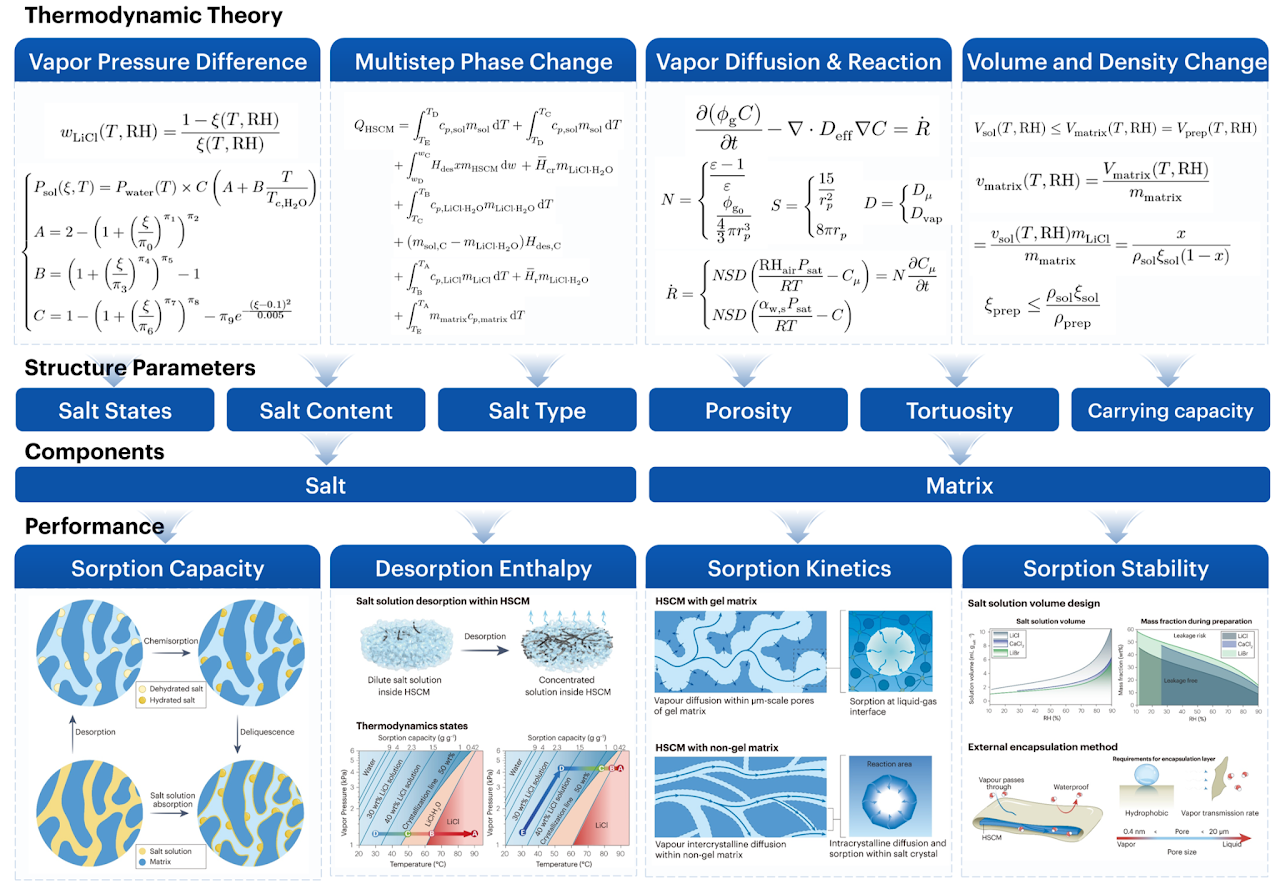
Thermodynamics for Hygroscopic Salt-Embedded Composite Materials Design
Materials performance sets the upper limit of system performance, especially for hygroscopic materials in atmospheric water-harvesting systems.
We present a design framework that models these materials as a ternary thermodynamic system of hygroscopic salts, host matrices, and water. Calculations draw on vapor-pressure differences, salt-water phase diagrams, differential enthalpy of mixing, and related thermodynamic descriptors. By linking structural parameters, such as salt type and loading, porosity, and tortuosity, to performance metrics including sorption-desorption capacity and kinetics, stability, and enthalpy, the framework connects complex structure to macroscopic performance.
This enables precise, predictive inverse design of materials tailored to local climate conditions and energy-input modes, delivering high performance and broad applicability.
Related publications
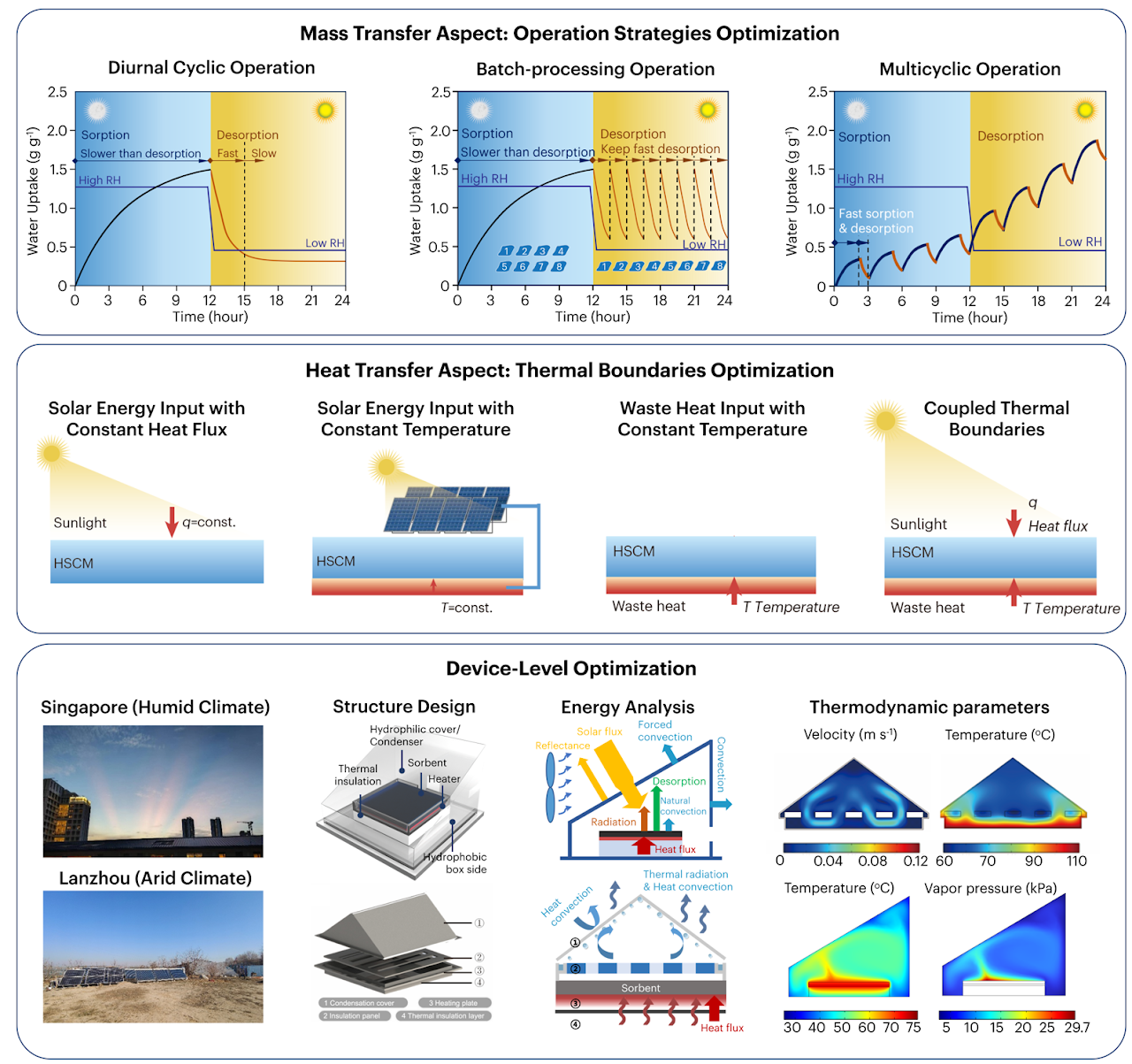
Heat and Mass Transfer for Practical Performance-First System Design
Translating materials-level performance to the system level requires careful system design.
We propose climate-adaptive operating strategies spanning arid to humid environments that address two major barriers: variations in thermal boundary conditions that govern water release from a heat-transfer perspective, and the intrinsic mismatch between sorption and desorption kinetics from a mass-transfer perspective. Addressing these factors enables system-level heat- and mass-transfer optimization, maximizing the joint use of atmospheric moisture and solar energy for a given climate.
This approach led to the development of, to our knowledge, the first portable, compact water harvester that produces more than 300 mL of water in arid conditions at a minimum relative humidity of 15%, while achieving equilibrium yields on the order of kilograms of water per kilogram of sorbent. We validated performance in field tests across three distinct climates: semi-arid Lanzhou, semi-humid Shanghai, and humid Singapore.
Related publications
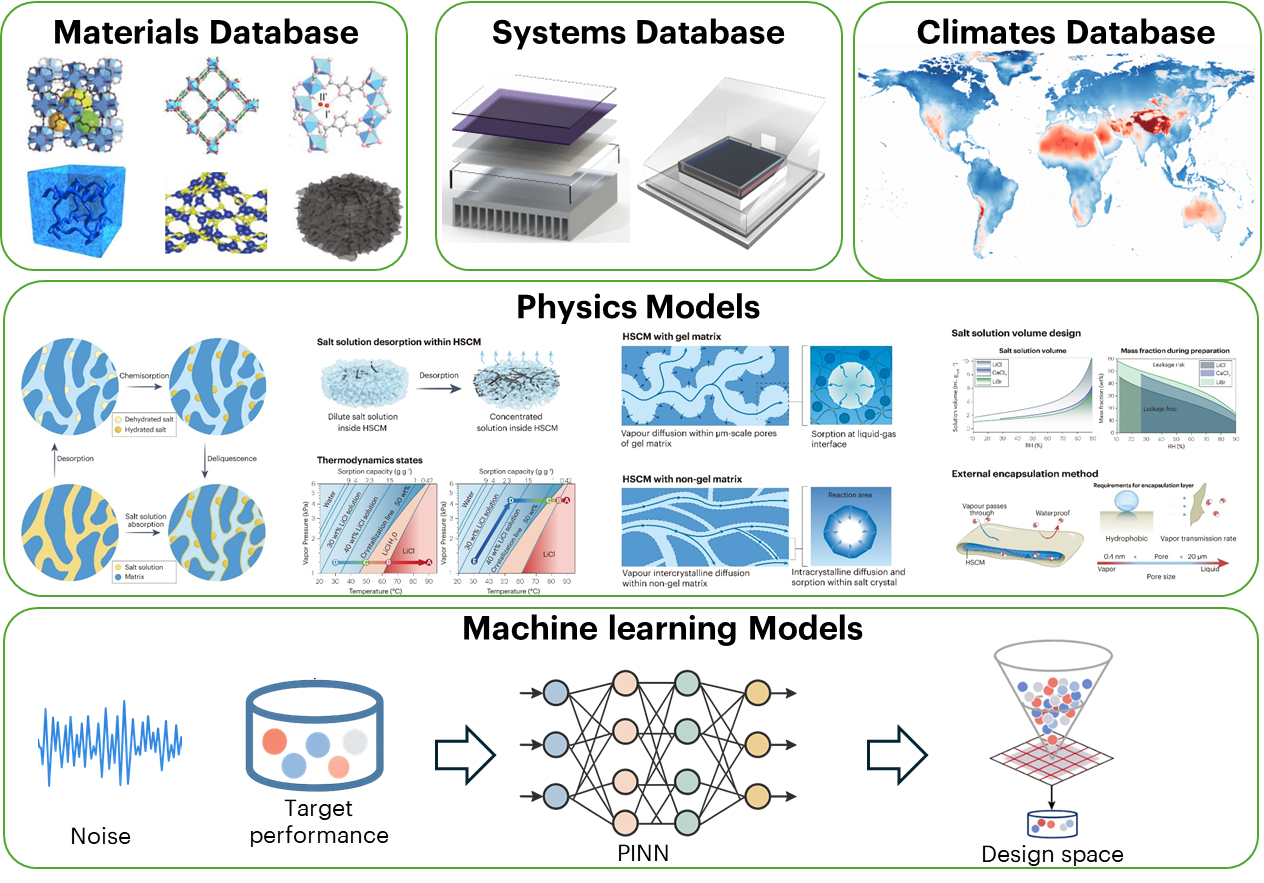
Machine Learning for Global Performance Prediction and Inverse Design
Sustainable energy–water systems often function as black boxes because their performance is highly sensitive to ambient conditions, including dynamic solar trajectories and environmental properties, as well as the real-time thermodynamic states of materials and devices. As a result, conventional physics-based models are often too computationally expensive or insufficiently scalable for reliable prediction, and they provide limited support for inverse design.
We address this challenge using machine-learning surrogate models. Physics-informed machine-learning approaches—including linear models, ensemble trees, gradient boosting, neural networks, and sequence models—are used to distill existing physics-based simulations into fast and accurate forward predictors. Meanwhile, conditional generative models and deep Q-networks can explore high-dimensional and complex state spaces for inverse design. Now we have already achieved a 10,000-fold acceleration in predicting daily water production at the global scale and accurate hourly water uptake curve responses.
Related publications